


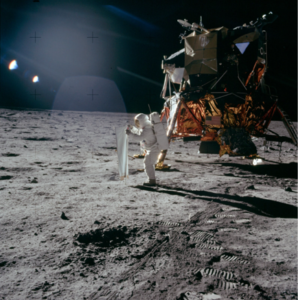
Humans have walked on the Moon. We have seen it in movies and old videos on the internet. Apollo 11 captivated a million viewers: the countdown, the ignition of engines, the rocket’s ascent beyond the clouds… then Neil Armstrong’s famous words, and astronauts hobbling in apparent slow-motion on the surface of the Moon. They took tools and experiments with them and brought back lunar rocks and new knowledge. It was an extraordinary achievement.
Now imaging instead a cargo ship leaving the port of Sines. Nobody gathers to watch this vessel depart or remembers its name. This shipment carries hundreds of containers filled with machinery, food, medicines and consumer goods. It crosses oceans, changes ports, unloads and reloads. These ceaseless, anonymous journeys keep the world’s economy moving. Thousands of similar shipments happen daily, but they are no longer remarkable. They are infrastructure.
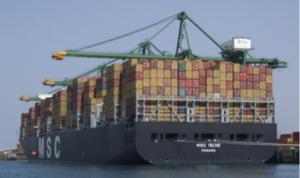
The future of the Moon may look much more like the second story than the first.
In the fifty years since people last walked on the moon, spaceflight has focused on exploration. We mastered rocket launches, achieved orbit, lived in space stations, and operated robotic spacecraft throughout the Solar System. Artemis II marks another milestone in this journey. It will return astronauts beyond low Earth orbit for the first time since Apollo, reminding us that humanity is preparing to venture deeper into space.
Yet, Artemis II marks a transition.
If people are to live and work on the Moon for years instead of just a few days, exploration must give way to permanence. A settlement cannot depend solely on occasional flagship missions or continuous supplies from Earth. It needs predictable transport, reliable power, robust communications, healthcare, construction, food production, resource extraction, and other services that we take for granted on Earth. In short, it needs an economy.
This shift changes the questions we ask. Instead of asking, Can we reach the Moon?, we begin asking, Who delivers cargo between Earth and lunar orbit? Instead of asking, Can we extract water from lunar ice?, we ask, Who buys it, who sells it and who turns it into useful products? Instead of asking, Can people survive on the Moon?, we ask, What kind of businesses make ordinary life possible?
These questions are less dramatic than rocket launches, but they are far more important. Every permanent human settlement in history has depended not on a single breakthrough, but on hundreds of specialized services working together. Ports required shipbuilders. Cities needed builders, doctors, farmers, teachers and merchants. Railways created industries that no one had imagined before the first tracks were laid. The Moon will be no different; many of those industries are already emerging.
Companies are developing reusable lunar landers. Others are designing communications networks around the Moon. Some are investigating how to produce oxygen from lunar soil, generate power during the two-week lunar night or grow food inside closed biological systems. These projects are often presented as isolated technologies, but they are pieces of a much larger puzzle.
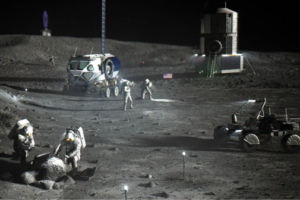
We are still determining whether each technology succeeds. The greater challenge is figuring out how they all work together. This is the core idea behind the Coimbra Space Summer School 2026.
This year’s focus is not on inventing a better rocket or designing a new spacesuit. Instead, participants will imagine themselves as founders of companies operating within an emerging lunar economy. Each team represents one sector (transportation, communications, infrastructure, energy, health, resources, food, or society) and develops a product or service that helps transform a small outpost into a permanent community.
No company can succeed alone. A transport operator needs navigation services; hospitals need reliable electricity; food production requires water, energy, and infrastructure; construction depends on local materials and logistics. Every sector provides services to others and relies on them in return. Together, they form an economy.
The goal is not merely solving a technical problem. It is identifying a real human need, understanding who experiences it, designing a credible solution, and explaining why someone would invest in it. Technology matters only because it enables people to do something previously impossible.
Over the coming weeks, this blog will explore the industries shaping humanity’s return to the Moon. We will ask who might become the DHL of cislunar space, who will build the first lunar internet, how cities can be constructed before builders arrive, why energy may become the Moon’s first public utility, how people maintain health in one-sixth of Earth’s gravity, whether lunar resources support profitable businesses, what it takes to grow food beyond Earth, and eventually, what transforms a scientific outpost into a place where people build ordinary lives.
The Moon has often been called the next frontier. Perhaps it is time to think of it instead as the next marketplace.
The first chapter begins with transportation.
References:
SpaceNews: Sustained lunar economy requires an integrated infrastructure of resilient systems
(spacenews.com)
PwC: Lunar market assessment
(pwc.com)
SpaceX IPO: Building the Space Economy for the AI Era
(pwc.com)
Pedro Lacerda, August 2026