


A permanent lunar settlement needs a reliable way to move people and cargo between Earth, lunar orbit and the surface. It also needs to move them across the Moon. Together, these services form a new kind of supply chain.
From one-off missions to regular schedules
Spaceflight still works largely through individual missions. Engineers design each mission around a spacecraft, payload and destination. Launch dates attract attention because every flight remains unusual. Such a system would not adequately supply a lunar settlement.
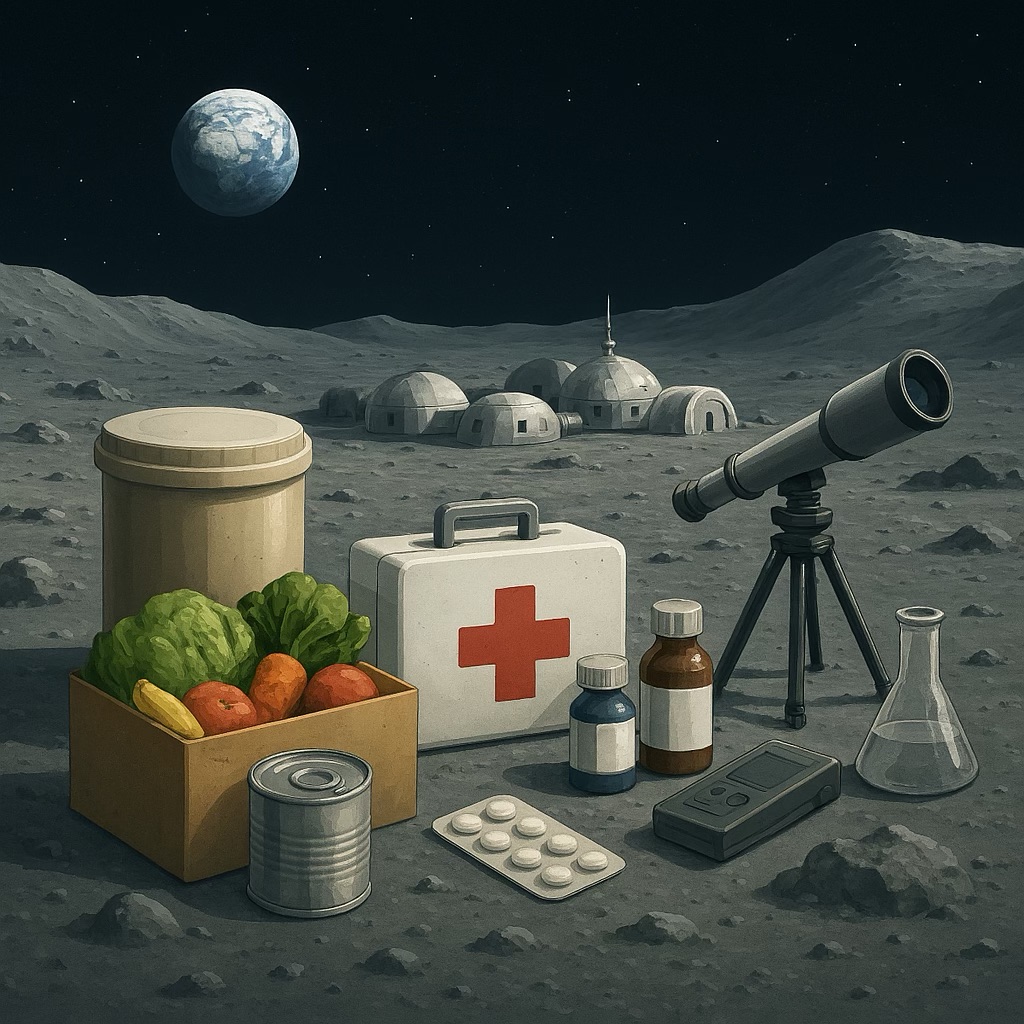
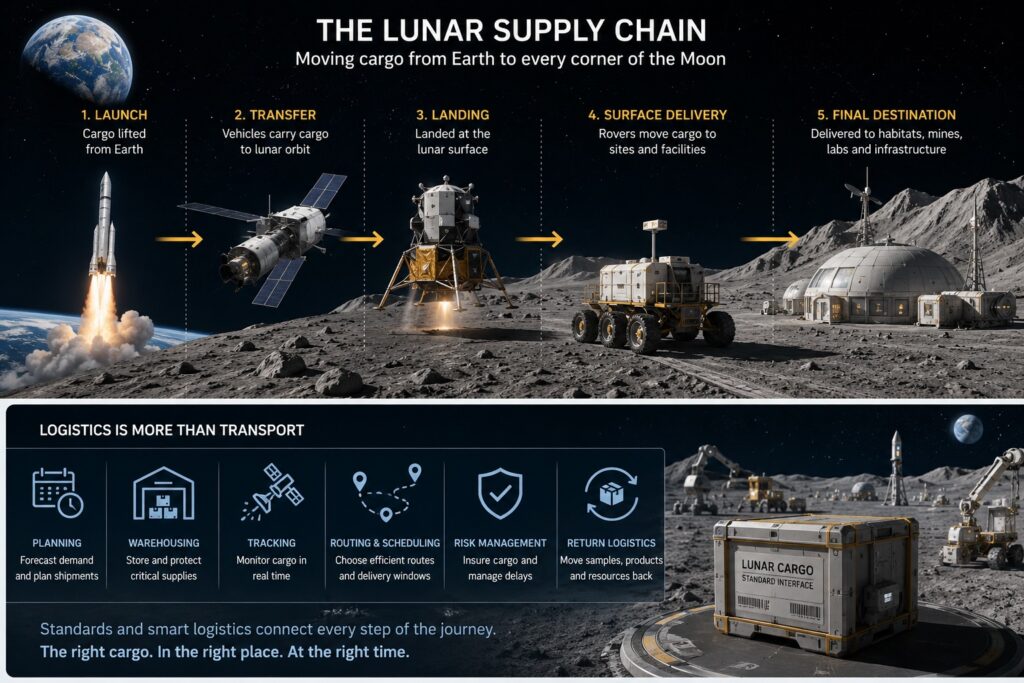
A community of people living near the lunar south pole will need food, medicines, scientific equipment, and spare parts. Construction sites will need materials. Laboratories will have to send samples elsewhere. New residents will arrive and some residents will leave. Businesses will need to move products between sites. The settlement will need transport at several scales and a network of specialized vehicles. Such a network could include launch vehicles, transfer vehicles, landers and surface rovers. Each would handle a different part of the journey from Earth to its final lunar destination.
NASA’s Commercial Lunar Payload Services program already gives an early example of this model. NASA buys lunar delivery services from commercial companies instead of developing every lunar delivery mission itself. Companies such as Intuitive Machines, Firefly Aerospace and Astrobotic have developed lunar delivery capabilities around this market.
Human exploration will add another layer. NASA’s Human Landing System program involves large lunar landers developed by SpaceX and Blue Origin. Other companies such as ispace are developing their own lunar transportation systems. These projects show pieces of a future transport network. A permanent settlement will require those pieces to work together with much greater regularity.
Standards make networks possible
Space is difficult to reach and the Moon is far. The lunar surface is a difficult place for logistics. Fine lunar dust can interfere with mechanisms. Large temperature changes affect equipment. Terrain can make relatively short journeys difficult. Vehicles must operate in vacuum and low gravity. These constraints will shape the vehicles, interfaces and services that lunar logistics companies develop.
Standards also become important, as they allow different transport systems to connect. On Earth, a shipping container can move from a ship to a train and then to a truck because each system accepts the same standard container. This simple agreement transformed global logistics by reducing handling costs and allowing different transport networks to connect.
Lunar logistics will need its own standard for connecting different transport systems. Standard interfaces could allow many companies to share the same transport network. A valuable product may thus be something less spectacular than a spacecraft. It could be a standard cargo container, an automated loading system or software that coordinates shipments.
Logistics means more than transport
A transport company moves something from one place to another. A logistics company makes sure the right thing reaches the right place at the right time. Consider spare parts. Shipping every possible replacement component from Earth early would overwhelm storage capacity and clutter supply lines. Shipping parts only after equipment fails could leave critical systems unavailable for days or weeks. A logistics provider could analyze failure rates, forecast demand and position critical components before customers need them.
Warehouses, cargo tracking, and scheduling could all become businesses. Companies could sell guaranteed delivery windows. They could offer priority shipments for medical or technical emergencies. Insurance companies could price the risk of lost or delayed shipments. Some vehicles could carry things in both directions. Samples, manufactured products or equipment could travel from the Moon to orbit or Earth. Water produced on the lunar surface could eventually become useful beyond the settlement if customers emerge in space. Logistics connects all these activities.
A network of customers
A lunar transport company could serve far more than astronauts. A mining company would need machinery delivered to an extraction site. A construction company would need regolith-processing equipment. A communications provider might need antennas delivered to remote locations. A greenhouse operator would need biological material and specialized equipment.
Transport companies depend on these industries for customers. These industries depend on transport companies to operate. Building a large transport system requires customers, but customers may hesitate to consider lunar operations until reliable transport exists. Early companies would therefore operate in a market where demand remains uncertain.
Government agencies and scientific institutions may be important early customers. Commercial operators may gradually add demand. Shared missions could combine cargo from several customers. Transport providers could sell capacity by mass, volume, destination or delivery time.
Opportunities
Several businesses could grow around this new lunar supply chain. One company might operate in cargo transport capacity between lunar orbit and the surface, while another might specialize in autonomous surface delivery rovers. A third might handle logistics coordination, all in software, coordinating shipments across several transport providers. Such a company would select routes, manage schedules, track cargo and respond to delays. Warehousing creates another opportunity. A company could maintain stocks of critical equipment on the lunar surface and sell rapid access to spare parts. An inventory management company could predict demand and decide which components to store on Earth, in lunar orbit or on the surface. These businesses solve different parts of the same problem: making movement predictable.
From extraordinary to ordinary
For CSSS participants working on transportation and logistics, the challenge is to identify one part of that future supply chain and turn it into a viable service. Consider the customers first. Map the complete journey of their cargo. Identify the expensive, slow or unreliable step. Then decide what your company can do about it.
Mature transport systems become less visible as they become more reliable. Most people do not know which ship carried their laptop across an ocean. They do not know which warehouse stored it or which software scheduled its journey. All they know is that it arrived. A permanent lunar settlement will need the same kind of reliability.
References:
– Explore NASA’s Commercial Lunar Payload Services
– Explore NASA’s Human Landing System
– Explore current and planned CLPS deliveries
Pedro Lacerda, August 2026