


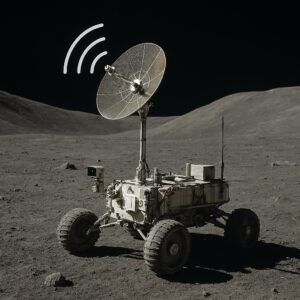
A rover leaves a lunar settlement and heads toward a mining site 30 kilometres away. It carries no driver. Its navigation system follows a planned route while sensors watch the terrain ahead.
Halfway there, the rover finds an obstacle and changes course. The operations centre needs its new position. The mining company needs to know when its equipment will arrive. Other vehicles need to avoid its route. Engineers need telemetry from its batteries and motors.
On Earth, these tasks rely on services we rarely notice. Mobile networks carry data. Navigation satellites provide position and time. Maps describe roads and terrain. Data centres process information. Network operators keep the system running.
A lunar settlement will need its own version of this digital infrastructure. Without it, transport, mining, construction, medicine and many other lunar industries would be difficult to operate.
Credit: AI Generated
Beyond the giant antenna
Communication with the Moon already works. Space agencies have communicated with lunar spacecraft for decades. Large antennas on Earth can transmit commands and receive scientific data across hundreds of thousands of kilometers.
A permanent lunar economy creates a different problem. A scientific mission can plan communication sessions around the availability of ground stations.
A settlement with dozens of residents, autonomous vehicles, mines, power systems and commercial services will generate continuous demand.
Some users will need basic telemetry. Others may transmit large scientific datasets or high-resolution video. Medical systems will need dependable links.
Autonomous machines will need to exchange operational data. Businesses will need secure communications. Residents will want ordinary personal communication with Earth.
The network will also need to reach places that cannot see Earth. The Moon keeps nearly the same face pointed toward our planet. A station on the lunar far side therefore has no direct radio link to Earth. Mountains, crater walls and local terrain can also block signals near the surface.
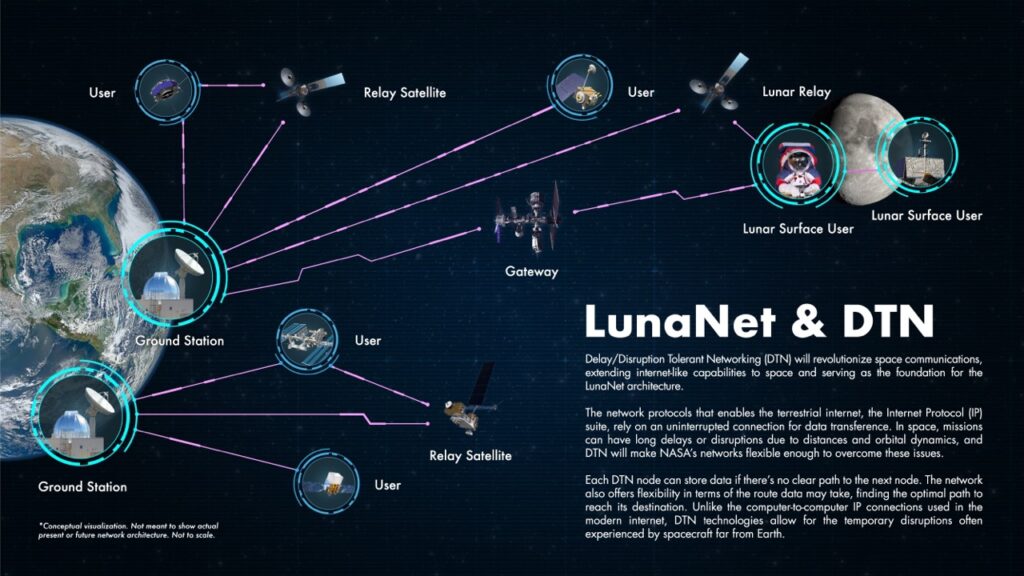
Relays can extend coverage. Satellites in lunar orbit can connect surface users with Earth and with one another. Surface antennas can fill local gaps. Optical communications may provide high-capacity links for some applications. The result is a network of orbital relays, surface antennas, local networks and Earth links.
 Credit: NASA
Finding your way without GPS
Communication solves only part of the problem. People and machines also need to know where they are. On Earth, satellite navigation has made positioning almost invisible. A phone can determine its location within seconds.
Aircraft, ships, tractors, financial networks and electrical grids also use satellite navigation. Many systems rely on its precise timing signals.
GPS and Europe’s Galileo constellation were designed primarily for Earth. Their satellites orbit our planet and direct their services toward terrestrial users.
Lunar operations need another solution. A rover traveling between a habitat and a mining site needs to know its position. A lander approaching the surface needs accurate navigation. Construction robots need common coordinates when they work together. Rescue teams need to locate people and vehicles. Scientific instruments need precise positions for their measurements.
Timing matters as well. Networks, power systems and distributed sensors often need to coordinate their operations.
ESA’s Moonlight program is developing lunar communications and navigation services around this need. NASA is also developing communication and navigation capabilities through its Near Space Network and related lunar infrastructure.
These programs point toward a future in which lunar users buy services instead of building a complete communication and navigation system for every mission.
The Moon needs coverage
A lunar network does not need to reproduce the terrestrial internet. Its architecture will follow lunar geography and economics.
Early lunar activity may cluster around the south polar region, where permanently shadowed areas may contain water ice and some elevated locations receive favorable illumination.
A network operator could begin with coverage around a few important sites. Satellites could provide broad regional connections. Surface stations could extend service into craters or behind terrain. Local wireless networks could connect equipment inside a settlement. Dedicated links could serve industrial facilities with demanding requirements.
Different customers will also need different levels of service. A tourist sending a message to Earth can tolerate an interruption. A remotely supervised excavation system may need much higher availability. A navigation service used during landing may require strong guarantees about accuracy and integrity. Providers could charge different prices for different levels of service.
Communication becomes a utility
A mining company does not necessarily want to own a satellite constellation, but it wants its machines to remain connected.
A transport company does not need to operate navigation beacons, but it needs accurate positions for its vehicles. A hospital does not need to build an Earth–Moon communications system, but it needs dependable access to medical expertise and data.
A communications company could sell bandwidth to lunar users. A navigation provider could charge for positioning services. Another company could provide local networks around settlements and industrial sites. A specialized operator could offer secure communications for government or scientific customers.
Service agreements could specify coverage, bandwidth, latency, availability or positioning accuracy. The same infrastructure could serve many customers. As the number of customers grows, the economics could improve because each new user does not require a completely new network.
A network for machines
Many early lunar customers may not be people. Robots may survey terrain, transport cargo, inspect equipment and prepare sites.
Some tasks can run autonomously. Others may require human supervision. A robot might operate independently until it encounters an unfamiliar situation, then send data to an operator and request assistance.
The Earth–Moon distance introduces a noticeable communication delay. A radio signal takes about 1.3 seconds to travel between Earth and the Moon. A command and response therefore take at least about 2.6 seconds, before processing and network delays. That makes direct joystick control from Earth unsuitable for many fast tasks.
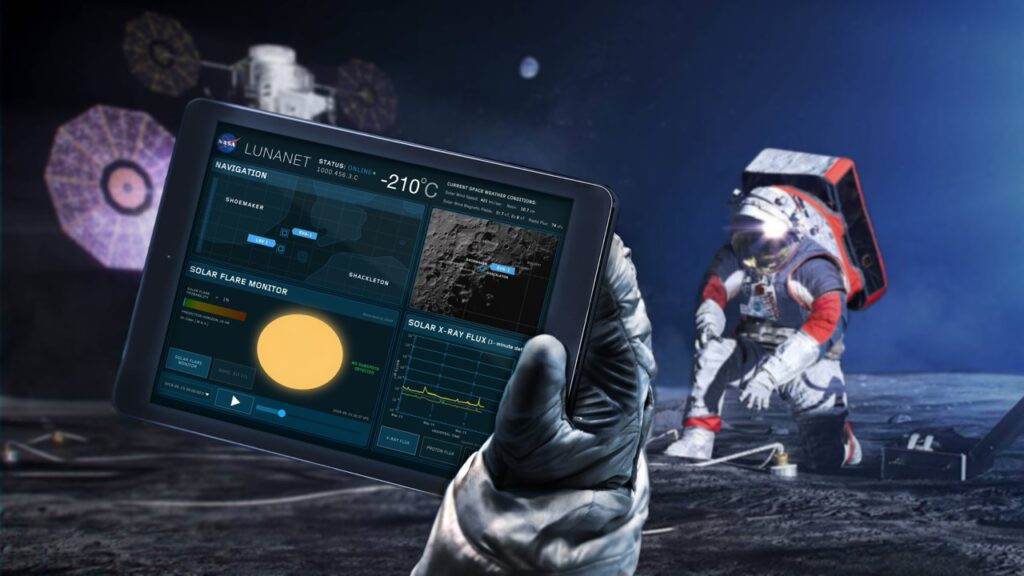
Greater autonomy can reduce this dependence. Lunar machines can make routine decisions locally while operators on Earth provide higher-level instructions. Local computing can process data before sending it across the network. Better communications and navigation can support greater autonomy, while greater autonomy reduces the need for continuous communication with Earth.
 Credit: NASA
From lunar networks to space awareness
Communications and navigation tell lunar operators where their own systems are and allow them to exchange information. A growing cislunar economy will also need information about other objects moving through the space around the Moon.
Spacecraft will move between Earth and the Moon. Satellites and other spacecraft will operate around the Moon. Transfer vehicles, landers and other systems will occupy different trajectories.
Operators need to detect and track objects to plan missions and reduce collision risks. This creates a link between communications infrastructure and space situational awareness.
Ground-based telescopes already track satellites and other objects around Earth. Future systems may extend these capabilities farther into cislunar space.
CSSS participants can explore these problems with Rafael Caldeirinha, from the Instituto de Telecomunicações, whose work includes radio propagation and wireless communications. His connection with PASO – Pampilhosa da Serra Space Observatory also links communications research with space observation and ground infrastructure.
Ignacio Reyes of Dunedain Space, a mentor at CSSS 2026, provides a direct connection to this problem. Dunedain Space develops telescope systems and related capabilities for observing and tracking objects in space. Such systems could contribute to the information infrastructure needed as activity expands beyond Earth orbit.
The lunar network may therefore carry more than messages. It may distribute information about the environment through which spacecraft travel.
Opportunities in the lunar network
A communications company could sell bandwidth between the lunar surface, lunar orbit and Earth. A navigation provider could sell positioning and timing services to landers, rovers, construction companies and scientific teams. A local-network operator could deploy compact base stations around habitats, landing zones, mines or power installations.
Software creates another layer of opportunity. One company could route traffic across several network providers according to cost, capacity and reliability. Another could combine navigation data, maps and object tracking into a common operational picture.
These businesses would sell different products, but they would share one characteristic. Their customers would include companies from almost every other sector of the lunar economy.
The network underneath the settlement
A lunar settlement can survive a delayed entertainment stream. It cannot treat every connection in the same way. A medical consultation, a landing operation, a mining robot and a personal video call place different demands on the network.
Communications providers will need to decide how to allocate limited capacity. Navigation providers will need to define the accuracy and reliability they can guarantee. Customers will need to decide how much they will pay for those guarantees.
For CSSS participants, the task starts with a specific user. Choose a rover, hospital, mining company, transport operator, scientist or resident. Define the information that user needs. Determine where it must travel, how quickly it must arrive and what happens when the connection fails. Then identify the service that can meet that need and the infrastructure required to provide it.
A lunar economy will move people, machines, energy and materials. Every one of those movements also depends on information. The companies that carry that information may become some of the Moon’s most important infrastructure providers.
For more information:
* ESA – Moonlight: Lunar Communications and Navigation Services – Explore ESA’s Moonlight program
* NASA – LunaNet: Communications and Navigation Interoperability – Explore NASA’s LunaNet
* NASA – Lunar Communications Relay and Navigation Systems (LCRNS) – Explore NASA’s LCRNS resources
Pedro Lacerda, August 2026