


Energy as the First Lunar Utility
Imagine a mining machine operating several kilometers from a lunar settlement. Its electric motors drive drills into the regolith, while pumps move material through a processing system. Heaters keep the equipment within its operating range, computers control the process and antennas maintain contact with the settlement.
The machine needs power throughout its operating period. Nearby habitats need power as well, along with communications systems, medical equipment, laboratories, greenhouses, rovers and construction machines. Some systems can shut down when electricity becomes scarce, but life-support systems cannot.
A permanent lunar settlement therefore needs more than power generation. It needs an integrated energy system.
That system must generate, store and distribute electricity, while also deciding how to allocate it. It must continue operating through failures in an environment where repair crews and spare parts may be limited.
This makes energy one of the basic industries of a lunar economy.
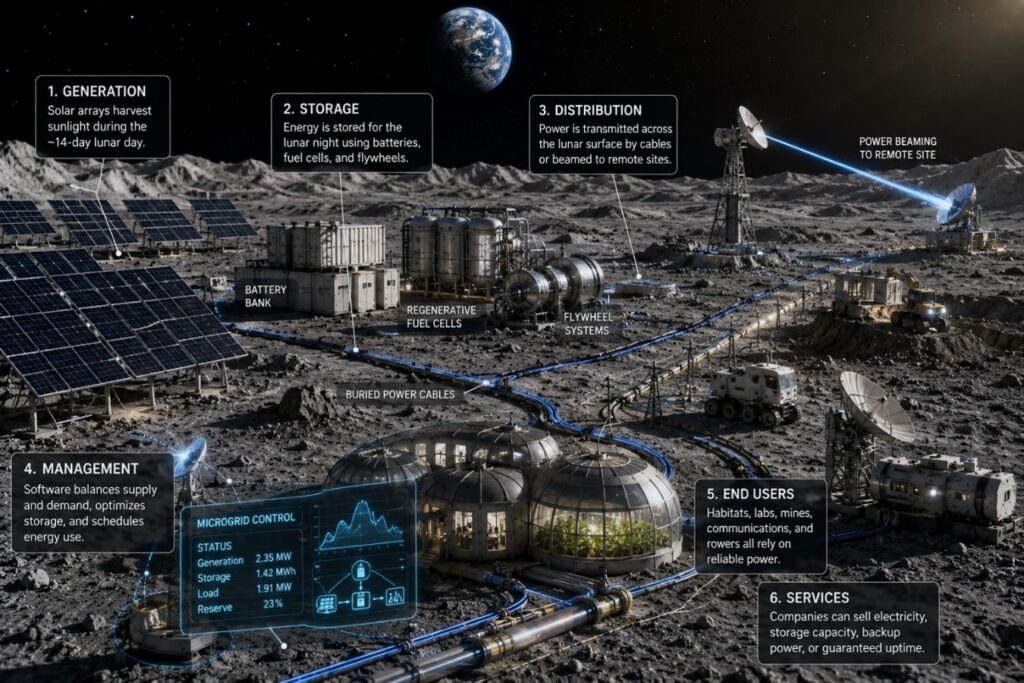
A difficult place to generate power
Solar energy is an obvious source of power for the Moon. Most spacecraft already use solar panels because they have few moving parts and can operate for long periods. A lunar settlement could use larger arrays to generate electricity for habitats, for machines, and for other infrastructure.
However, the lunar environment complicates things. A solar day on the Moon lasts about 29.5 Earth days. Across much of the surface, this means roughly two weeks of daylight followed by two weeks of darkness. Away from favorable polar sites, a solar installation would therefore need substantial storage to operate through the long lunar night.
Conditions near the lunar south pole are different. The Sun stays low on the horizon, and some elevated locations receive sunlight for long periods. Nearby craters can remain in permanent shadow.
Terrain therefore becomes part of energy planning. Two sites separated by a few kilometers may have very different access to sunlight. A good habitat location may not be the best location for a solar array. A mining operation may need power inside or near a shadowed crater.
Storing the day
A solar-powered system needs a plan for periods without sunlight. Batteries are one option. They store electricity when generation exceeds demand and release it when demand rises. They can also respond quickly to changes in power use.
Lunar nights make this task more demanding. A solar-powered system that must operate through darkness needs enough stored energy to keep critical systems running. Large battery banks add mass and require thermal control. Their performance also depends strongly on temperature and repeated charge-discharge cycles.
Other storage technologies may suit different settlements. Regenerative fuel cells convert sunlight into chemical energy and release it when power is needed. Flywheels store energy in rapidly rotating masses and later convert that motion back into electricity. No system is best in every category. Each involves trade-offs among mass, storage duration, efficiency, service life, and reliability.
A lunar energy company could therefore sell storage as a service. A customer might own solar panels but pay another company to guarantee power during periods of darkness. A mining operator might purchase additional capacity for a temporary site. A habitat might pay for emergency reserves that it rarely uses. In this model, stored energy becomes a product.
Nuclear power on the surface
Nuclear power systems offer an alternative source of continuous power. They can operate during darkness and in locations where solar generation is difficult. This makes nuclear power attractive for long-duration surface operations.
NASA and the US Department of Energy have been developing concepts for fission surface power on the Moon. Rolls-Royce has also studied a space micro-reactor for lunar applications.
A lunar reactor would introduce its own engineering and operational requirements. It would need to be transported to the Moon, installed, cooled, controlled and shielded. Operators would also need procedures for safety, maintenance and, if necessary, shutdown. Its main value may be reliability.
A settlement could combine nuclear and solar power rather than rely on a single source. Solar arrays could provide low-cost electricity when illumination is favorable. Nuclear systems could supply continuous baseline power, while storage could manage short-term changes in supply and demand. The lunar grid may therefore use several technologies at once.
Moving electricity across the Moon
Generation is useful only when power can reach the customer. A settlement may cover a large area, with habitats, landing zones, communications stations, mines and scientific instruments located at separate sites. The best solar locations may also be far from the facilities that use the electricity.
Cables are an obvious solution. Robots could deploy power lines across the surface and connect new facilities as the settlement grows. Long cables also create risks. Vehicles could damage them, while dust and repeated temperature changes could degrade connectors and other components.
Power beaming offers another option. Microwaves or lasers could transmit energy to remote sites, where receivers would convert it back into electricity. This could serve isolated equipment without a continuous physical cable.
The lunar microgrid
A small settlement could use a network of connected microgrids. Each habitat could have its own solar panels, batteries and backup supply, while a mining site or communications station operates a separate system. Connections between the microgrids would allow one site to support another during a shortage.
Software would manage these exchanges. An energy-management system could forecast production and demand, charge batteries when excess power is available and reduce non-essential consumption during shortages. It could also schedule energy-intensive industrial processes for periods of high generation.
This flexibility matters because lunar businesses may be able to adjust when they use power. A mining company could run processing equipment when electricity is abundant, while a greenhouse could shift some lighting cycles. Batteries in parked rovers could provide temporary storage, and construction equipment could charge during periods of excess generation.
The settlement could therefore manage both supply and demand. This would create a market for energy-management software.
Not every kilowatt-hour has the same operational value. A construction robot may stop for several hours, while a medical system needs continuous power. Providers could therefore sell different levels of service, from interruptible electricity to guaranteed supply backed by storage and reserves.
The Sun provides energy and risk
Solar activity also links the energy sector to the wider space environment. Ricardo Gafeira, from the University of Coimbra (UC) and the Institute of Astrophysics and Space Sciences (IA), works in solar physics. His research examines the Sun and the physical processes that produce solar activity. Teresa Barata, also from UC and IA, studies how solar activity and space weather affect different economic sectors.
For lunar operations, the Sun has two important roles. It provides energy for solar installations, but it also produces radiation and energetic events that can affect people and technology. The Moon lacks the global magnetic field and thick atmosphere that protect people and infrastructure on Earth. Ricardo and Teresa’s perspectives can help participants understand the environment on which a solar-power business depends.
Selling power in 2045
Lunar energy could support several kinds of companies: solar and nuclear power providers, microgrid operators, storage services, surface distribution companies and energy-management software. Some could sell electricity by the kilowatt-hour. Others could sell storage, backup power or guaranteed uptime.
The CSSS settlement will begin with 1,000 residents and plans to grow to 10,000. Energy teams should select a customer and define its demand. They should estimate when the customer needs power and how serious an interruption would be. The business model should also account for growth.
They should then identify the electricity source, storage method and delivery infrastructure. These choices should match the customer’s operating requirements.
The next step is to define the product. A customer might buy electricity, lease batteries, pay for guaranteed backup power, subscribe to a managed microgrid or purchase a fixed supply for a remote lunar site.
Remember the cross-sector dependencies. Every machine in the settlement will need energy, but energy companies will also depend on other sectors. They need transport to deliver equipment, infrastructure to prepare sites, and communications to control distributed systems.
References:
– NASA – Watts on the Moon Challenge
– NASA – Fission Surface Power
– ESA – Exploring the Lunar South Pole
Pedro Lacerda, assisted by AI, August 2026