


A small cargo spacecraft lands near the lunar south pole, carrying equipment for a new habitat. No construction crew waits for it. There are no cranes, roads or electrical grids. The landing site may need preparation before larger spacecraft can use it safely. The habitat needs a stable foundation, power, communications, and protection from radiation and lunar dust. Every kilogram of construction equipment brought from Earth adds to the cost of the settlement.
The first lunar builders may therefore be machines.
Robots could prepare landing areas, clear routes, excavate regolith, move materials and assemble structures before residents arrive. Later, they could expand and maintain the settlement while people live nearby. A permanent community needs places to live and work, along with the infrastructure that connects them.
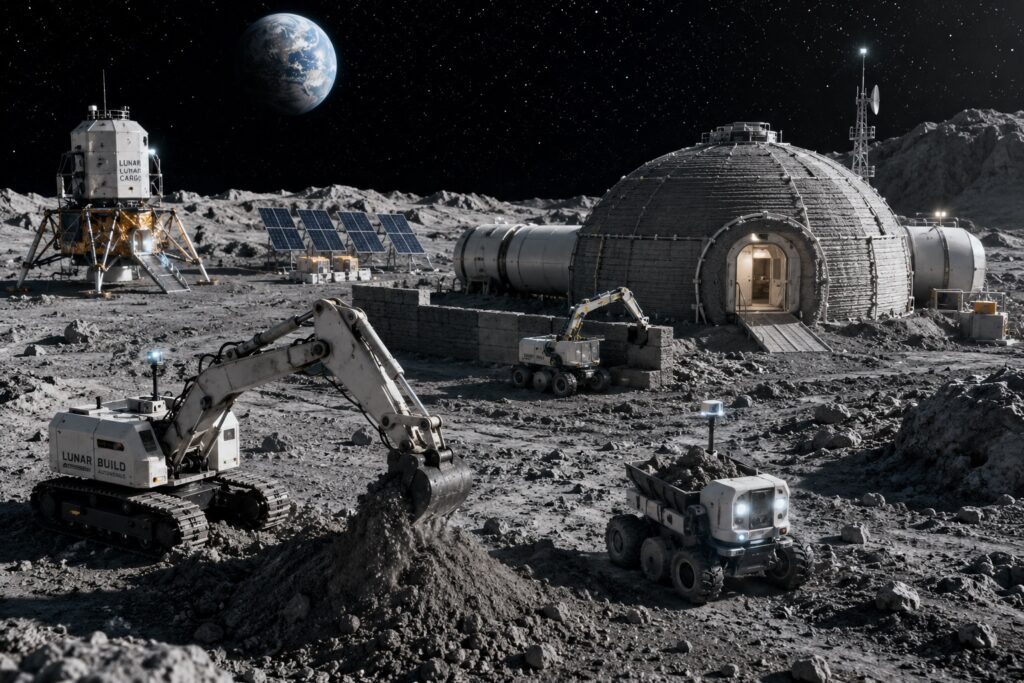
Building in an unfamiliar environment
Construction on Earth relies on things and services that we rarely notice. Workers can breathe the air. Roads carry heavy equipment. Suppliers deliver replacement parts. Specialists can travel to a site when something goes wrong.
The Moon provides none of these services.
Buildings and equipment must work in vacuum and survive large temperature changes. Radiation threatens people and electronics. Lunar regolith contains fine, abrasive particles that can enter mechanisms and damage equipment. Gravity is about one-sixth of Earth’s. This changes the loads on structures and the behavior of soil and dust during excavation and transport. Equipment will also need to work for long periods with few spare parts and specialist maintenance. These conditions will affect lunar buildings, construction machines and the businesses that support them.
A settlement is more than a habitat
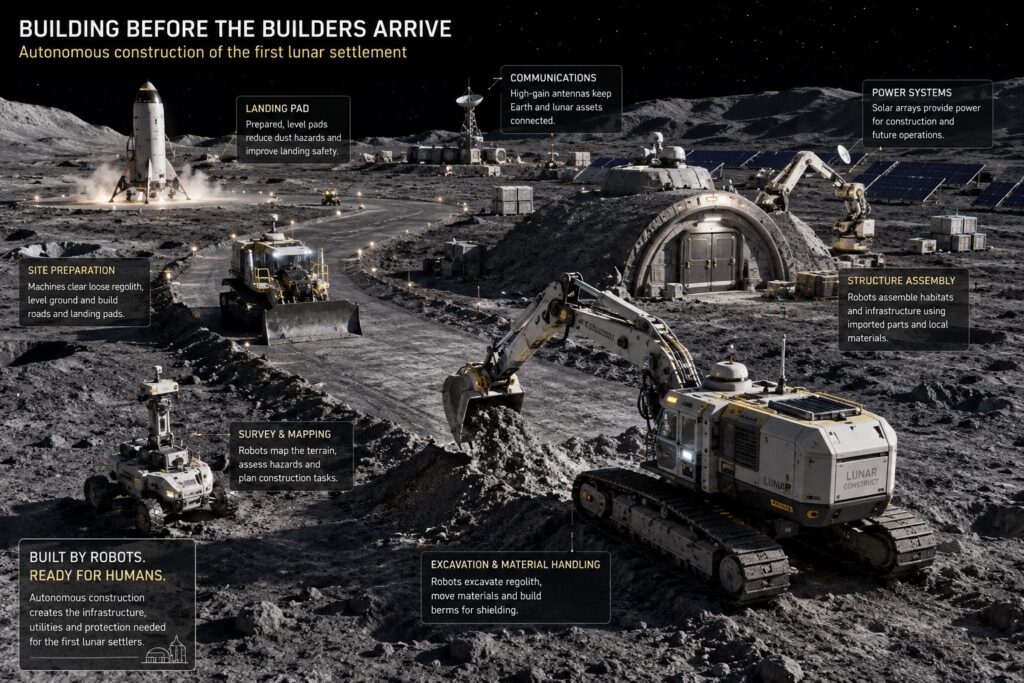
Images of lunar settlements often show habitats. A working settlement will need much more. It may include landing pads, roads, power stations, laboratories, workshops, and greenhouses. Mines may lie kilometers from the main settlement. Solar power systems may be built where they receive more sunlight. Routes for power cables, communication lines, and pipes could carry power, communications and fluids between these locations.
Landing areas create a specific infrastructure problem. Rocket exhaust can accelerate loose lunar material during landing and take-off. Dust and larger particles can threaten nearby equipment. Prepared landing surfaces, barriers and careful site layouts could reduce this risk. A lunar construction company may therefore build landing pads and roads before it builds houses.
Use what is already there
Transport from Earth will remain expensive. Local materials could become increasingly useful as the settlement grows.
The most abundant construction material already covers the lunar surface.
Regolith could provide radiation shielding around habitats. Machines could excavate it and pile it over structures brought from Earth. More advanced processes could turn it into bricks, tiles or other building parts. Researchers have also studied sintering and additive manufacturing techniques that use lunar material.
NASA’s Moon to Mars Planetary Autonomous Construction Technology (MMPACT) program has investigated autonomous construction using materials available at the destination. NASA has also worked with ICON on large-scale additive construction technologies for lunar applications.
Local materials will not eliminate the need for supplies from Earth. Excavators, robots, electronics, and specialized parts may still come from Earth, while processing regolith needs energy and machinery. This connects construction with lunar resources. A resource company could supply processed regolith to a construction company. Both would need standards for the material, its strength, and its delivery. One lunar company becomes the supplier of another.
Building before people arrive
Automation could allow construction to begin before a site can support a large construction crew.
A robotic construction company might receive a construction site months before residents arrive. Its machines could survey the terrain, prepare a landing zone, level routes, excavate material and prepare foundations. They might bury cables, install barriers or cover habitats with shielding.
Human operators on Earth could supervise some of this work. Communication delays and interruptions would limit direct control. The machines would need enough autonomy to do routine tasks and work safely when conditions change.
They would also need to continue working after a failure. A broken excavator cannot simply wait for a mechanic and a replacement component from Earth. Equipment may need modular parts, diagnostic systems, and robotic maintenance. A fleet of smaller machines could continue working after one unit fails. A lunar construction company could therefore guarantee that work continues.
Habitats are systems
A lunar habitat must do more than provide walls and a roof. It must maintain pressure, control temperature and humidity, limit radiation exposure and manage lunar dust.
Its design also affects the people who live there. Residents need places to sleep, work, eat, exercise and spend time alone. Noise, lighting, privacy, and layout can affect daily life in a confined environment.
Infrastructure therefore connects directly with Health & Human Performance. Medical and human-performance specialists can specify limits for temperature, radiation, air quality, lighting, and other conditions. Designers and construction companies must turn those requirements into physical systems. The habitat becomes part of the life-support system.
Infrastructure as a service
A lunar infrastructure company does not need to sell buildings. It could sell prepared sites.
A laboratory operator might lease a site with power, communications and radiation shielding already available. A mining company could rent an industrial site with roads and utility connections. A transport company could pay to use a maintained landing zone.
This model resembles industrial parks, airports and utility networks on Earth.
Other companies could lease construction robots, sell modular habitats or maintain existing infrastructure. Sensors could monitor structures while robotic systems inspect surfaces, remove dust and make repairs.
The customer could pay to use shared infrastructure instead of owning every machine needed to build and maintain it.
Different customers will need different sites. A laboratory needs stable temperature, pressure, and other conditions. A mine needs heavy machinery and large amounts of power. A greenhouse needs light, water, and temperature control. Modular systems and standard interfaces could allow infrastructure to expand as their operations grow.
Opportunities on the lunar surface
Lunar infrastructure could create opportunities for several kinds of companies: autonomous site-preparation services, regolith construction, shared industrial sites, habitat maintenance, dust control, modular power, communication, and fluid connections, and automated cable deployment.
Each would depend on other sectors. Construction needs energy. Robots need communications and navigation. Local materials connect infrastructure with resources and manufacturing. Habitats connect construction with health and human performance.
Infrastructure sits at the center of much of the lunar economy.
Designing the first layer
For CSSS participants working on infrastructure, the task starts with a customer and a place.
Choose the site. Identify the lunar conditions that make construction difficult. Decide which materials come from Earth and which could come from the Moon. Determine which machines perform the work and how they receive power and communications. Identify the other companies your service depends on. Finally, define what the customer buys: a habitat, a prepared landing pad, a kilometer of road, a ton of radiation shielding, or a serviced industrial site.
The first lunar settlement will need buildings, along with the roads, utilities, landing zones, and construction services that allow those buildings to work as part of a growing community.
References:
– NASA – Moon-to-Mars Planetary Autonomous Construction Technology (MMPACT)
– NASA + ICON – Lunar construction technology
– ESA – 3D Printing Our Way to the Moon.
AI + Pedro Lacerda, August 2026