


Resources and Manufacturing for a Lunar Economy
In the 2009 film Moon, a largely automated industrial base extracts helium-3 from the lunar surface and sends it to Earth. This technology belongs to science fiction, and helium-3 may never become an important lunar product. However, the film raises a useful question: what happens when the Moon becomes a source of materials rather than only a place where materials are delivered?
A real lunar settlement would face this question. Everything sent from Earth will have an added transport cost. Some products will continue to come from Earth because they are difficult to make locally. Others could eventually be extracted, processed and manufactured on the Moon. At the same time, global trade has shown that goods do not always need to be made close to where they are used.
The economic opportunity lies in deciding which approach works best for the lunar economy. This is also a familiar idea in science fiction, from The Moon Is a Harsh Mistress, by Robert Heinlein, to more recent stories about settlements that must build local industries to survive.
What can the Moon provide?
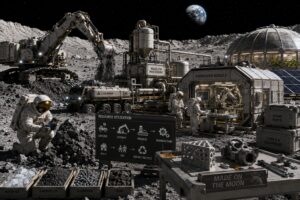
The lunar surface has no forests or rivers. It does, however, contain enormous quantities of rock and regolith: the loose layer of material that covers the bedrock. It also contains smaller quantities of other resources that could become useful to a settlement.
Water is particularly interesting. Permanently shadowed regions near the lunar poles can retain water ice, although its quantity, distribution and accessibility are still being studied. If lunar water can be extracted at a reasonable cost, it could support several industries.
People and many industrial processes need water. When separated into hydrogen and oxygen, it can also support life-support systems and, potentially, rocket propulsion.
Regolith provides another important resource. It contains oxygen chemically bound in minerals, as well as silicon, aluminum, iron, titanium and other elements. Extracting these materials requires energy and suitable processing equipment, but some could eventually become raw materials for construction and manufacturing.
The important question is therefore not only what exists on the Moon. A business must also know what can be extracted, at what cost and for which customers.
From rock to product
Knowing that a resource exists does not make it useful. A company must locate it, excavate it, separate the desired material and turn it into a product with predictable properties. The complete process must also be affordable.
Consider water ice. A mining operation could first map an area to identify promising deposits. Robots could then excavate icy regolith and deliver it to processing equipment. Heat could release the water vapor, which the system would collect and purify.
Each step needs equipment, energy and maintenance. Work inside a permanently shadowed crater creates additional problems because temperatures can be extremely low and sunlight may not be available.
The same principle applies to metals and oxygen. Regolith must be collected and processed before its useful components become products. This is the practical side of in-situ resource utilization: using local materials instead of importing everything from Earth.
This process could create opportunities for several companies. One might survey deposits, another could build excavation machines and a third could operate the processing equipment. Other companies could transport the finished product or certify its quality.
A lunar mine could therefore become a customer for many other lunar businesses.
The first market may be next door
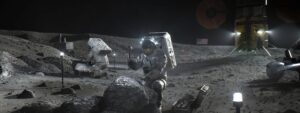
Lunar mining is often discussed in terms of valuable materials that could be sent back to Earth. That may not be the best place to start. The first customers for lunar resources may already be on the Moon.
A construction company could buy processed regolith for landing surfaces or radiation shielding. A habitat operator could buy water. An energy company might need materials for storage or industrial processes. Transport companies could eventually buy locally produced propellants.
This changes the economic calculation. A lunar material does not necessarily have to compete with the price of the same material on Earth. It needs to compete with the cost of delivering that material to the place where the customer needs it.
A kilogram of ordinary material can therefore become valuable if the alternative is transporting it across hundreds of thousands of kilometers. In this way, a lunar economy may first develop around local demand rather than exports to Earth.
Making things where they are needed
Extraction solves only part of the problem. A settlement will also need manufactured products. At first, sophisticated electronics, medical equipment and precision machinery will probably continue to arrive from Earth. Lunar manufacturing is more attractive for products that are heavy, relatively simple and needed in large quantities.
Construction elements are an obvious example. Regolith could be compacted, sintered—heated until the powder becomes solid—or processed in other ways to create shielding and building materials. Metal extracted locally could eventually be used for plates, tools or mechanical components.
Additive manufacturing could meet a different need. Instead of storing every possible spare part, a settlement could keep digital designs and manufacture some components when required.
This does not mean that a lunar workshop could print anything. A part needs the correct material, dimensions and mechanical properties. Critical components may also need inspection and certification before they can be trusted inside a pressure vessel, rover or life-support system.
Manufacturing would therefore create another possible business: quality control.
Repair before replacement
Local manufacturing becomes especially useful when equipment fails. On Earth, a company can order a replacement component and receive it within days. On the Moon, the same failure could stop a machine while a replacement waits for a suitable launch and delivery opportunity.
A lunar workshop could change this calculation. It might machine a replacement bracket, print a pipe fitting, repair a damaged tool or rebuild a worn component. The replacement would not always need to be identical to the original if it could perform the same function safely.
This makes repairability an important part of product design. Equipment intended for lunar use could use modular components, standard fasteners and replaceable parts. Manufacturers might provide certified digital files so that approved workshops could produce replacements locally.
The product could therefore be the design rather than the physical object. This idea also appears in science fiction, where settlements depend on local workshops and shared technical knowledge rather than large stocks of imported equipment.
Standards create a market
A resource company cannot simply deliver a container marked “lunar regolith.” Its customer needs to know what the container contains and whether the material is suitable for its intended use.
A construction company may need a specific particle size or composition. A manufacturer may need metal with known properties. A life-support operator may require water that meets defined purity standards.
Standards make these transactions possible, as discussed in an earlier blog post.
Testing laboratories could measure composition and mechanical properties. Certification companies could verify material batches. Digital systems could record where a material came from and how it was processed.
These activities may sound less dramatic than mining the Moon, but they turn raw material into something that another company can confidently buy.
Opportunities in lunar resources
The sector therefore extends from the ground beneath a settlement to the products used inside it. A company could map deposits, excavate regolith, extract water, recover oxygen or process metals. Another could manufacture simple components or operate a shared workshop for several customers.
Other businesses could provide equipment rather than materials. They might lease excavation robots, maintain processing plants or supply instruments that measure the quality of extracted resources.
The strongest opportunities may exist between sectors. A mining company needs energy and autonomous machines. A manufacturer needs raw materials and reliable specifications. Construction companies need bulk materials. Transport companies move equipment and products between sites.
No resource has much value until someone needs it. This is true on Earth, and it will also be true on the Moon.

What should be made on the Moon?
For CSSS participants, the central business question is what to make locally and what to import. Start with a customer and a product, then identify what that customer currently receives from Earth.
Estimate how much is needed and why transporting it is expensive or inconvenient. Then ask whether lunar materials or local manufacturing could provide a useful alternative.
Follow the complete supply chain. Where is the raw material? How is it identified, excavated and processed? How much energy does this require? How does the product reach the customer, and what quality must the supplier guarantee?
John Pereira II’s Day 1 keynote can help teams think about lunar resource exploration and assessment. During mentoring, Teresa Seixas and Manuel Salgueiro da Silva can provide useful perspectives on prospecting, spectroscopy, mineral characterization and ISRU.
The answer does not have to be a giant lunar mine. It could be purified water, radiation shielding, a replacement part or access to a machine shop.
The first lunar economy will still depend heavily on Earth. Every useful product made from lunar material removes one more item from the list of things that must cross the space between the two worlds.
That is where lunar resources become an industry.
For further reading:
– NASA: In-Situ Resource Utilization
– NASA: Lunar Surface Technology
– Space Resources Roundtable 2026
Pedro Lacerda, assisted by LLMs (August 2026)